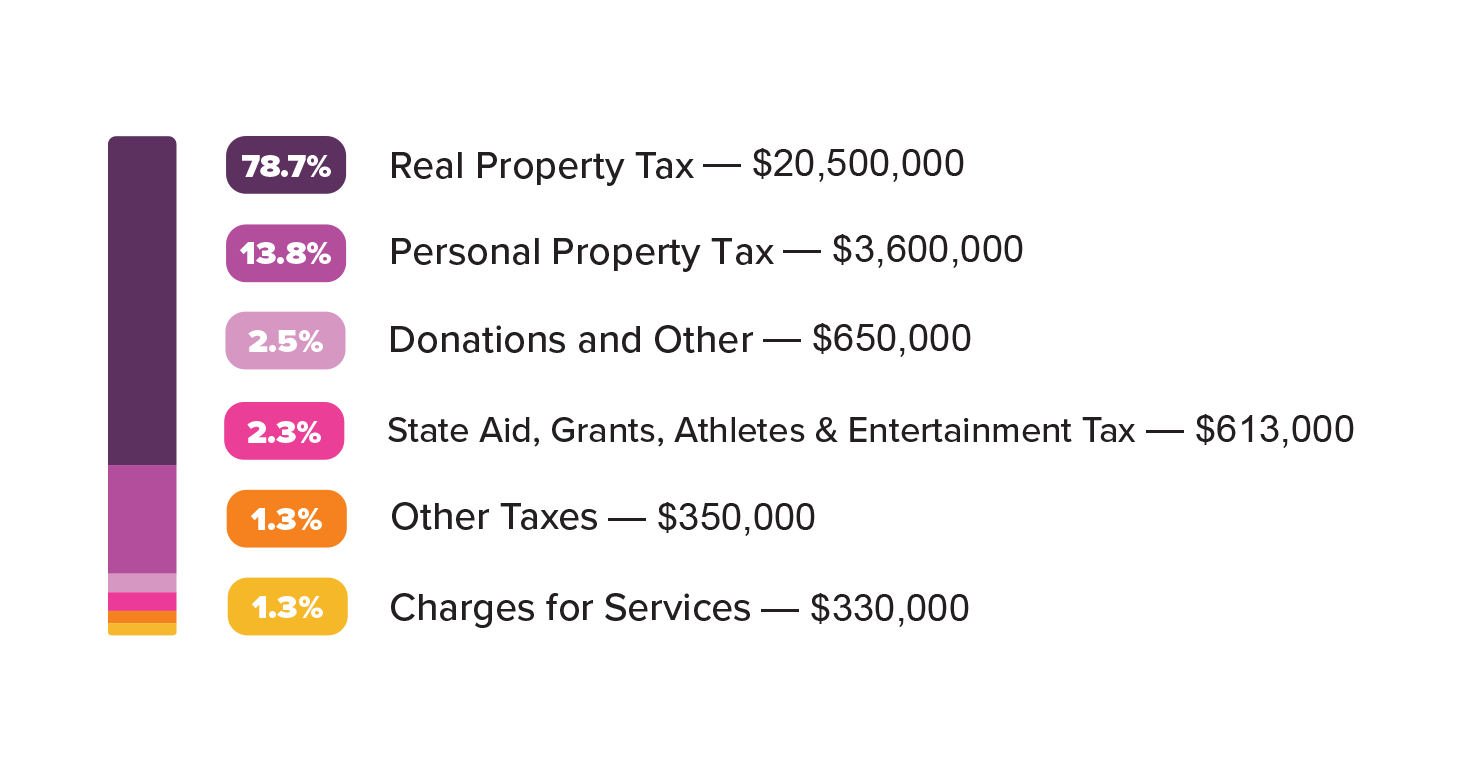
The St. Charles City-County Library is 93% funded by local property taxes, with a small amount of supplemental support from state aid, fees, investment earnings, and private donations through the Library Foundation and the Friends of the Library. The St. Charles City-County Library has not increased its levy in 32 years.
Slow Defunding
Hancock Amendment - The Hancock Amendment requires political subdivisions like the St. Charles City-County Library to roll back its voter-approved levy when property values grow faster than the Consumer Price Index (CPI) or 5%, whichever is less. The Library’s voter-approved levy is $0.26 per $100 in assessed valuation in accordance with the Hancock Amendment; the Library has rolled back its levy to $0.1668 (36% reduction). However, many costs that libraries face — such as healthcare for employees, utilities, technology, materials, and insurance have grown faster than CPI. Therefore, the Library’s actual expenses are growing at a rate greater than inflation, creating a funding gap.
Senior Citizen Property Tax Freeze Credit - For the St. Charles City-County Library, the impact of the Senior Citizen Property Tax Freeze Credit in 2026 is $160,000 which will increase as property valuation goes up. The approximate five-year impact is projected to be $1 million. The law requires that the amount of the Senior Citizen Property Tax Freeze Credit be counted as revenue (although not received) when the Library calculates its tax rate under Hancock. As a result the Library must roll back its levy based on funds never collected. This creates a permanent reduction in its tax rate and an ongoing loss of revenue beyond the credit.
Proposition RT (Prop RT) - Also known as Missouri’s Senate Bill 3 (SB 3) was passed in 2025. This bill, approved last summer and scheduled for a public vote in April, is projected to reduce Library revenues by approximately $444,000 in 2027 and $3.8 million over five years. Like the Senior Citizen Property Tax Credit, this amount will increase as property valuation increases and the Library will be required to further roll back its tax levy based on funds never collected.
Tax Abatements - Tax abatements and incentive programs in Missouri, including Chapter 68, Chapter 100, Chapter 353, TIF, and similar mechanisms, divert property tax revenue that would otherwise go to the Library. These programs allow municipalities to capture voter-approved funds for economic development or redevelopment projects, reducing the library’s funding base and constraining the Library’s ability to maintain services. These programs capture nearly $600,000 annually from the St. Charles City-County Library.
Proposal to Eliminate Personal Property Tax - Personal property taxes account for nearly fifteen percent (15%) of the St. Charles City–County Library’s revenue, generating approximately $3.6 million annually. Eliminating this revenue source would have significant service impacts, potentially requiring branch closures without voter approval of an alternative form of taxation.
While the impact of any one of these programs appear modest on its own, the cumulative effect of these reductions has a significant effect on the Library’s ability to sustain services and operations.
Real Impacts
These measures have already been taken by the Library.
![Bar graph showing 13% reduction in workforce [note1], 9% reduction in collection budget [note2], 70% reduction in capital spending [note 2]](/sites/default/files/inline-images/graph-bottom.png)
Notes: 1 From fiscal year (FY) 2020 to FY 2027.
2 from FY 2025 to FY 2026.
Why it Matters
- Over 6 million books and materials circulated each year
- 1.2 million Library visitors annually
- 5,000+ programs supporting early childhood literacy and lifelong learning
- 28,845 hours of meeting space used by individuals and community groups
- 51,000 items delivered to outreach customers
- 65,500+ hours of public computer use
- Passport, notary, technology and printing services, and free Wi-Fi
Answers to frequently asked questions: